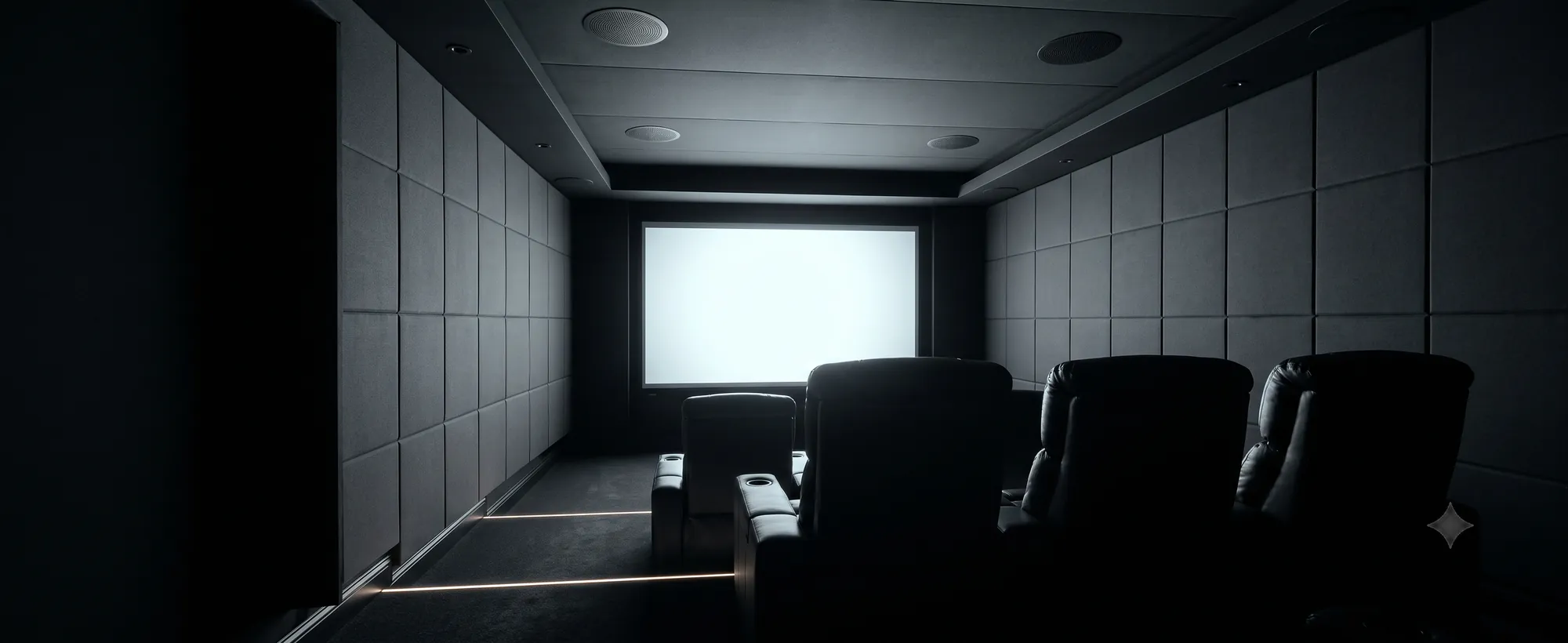
A speaker measured in an anechoic chamber and the same speaker in your living room produce very different sound at the listening position. What changed is not the speaker. Every hard surface in the room returns energy back at you, delayed and altered, and what you actually hear is the sum of the direct sound and all of those reflections.
This is why two people with identical equipment can have completely different experiences, and why upgrading a receiver rarely fixes a room problem.
Reflections and clarity
Sound reaching you straight from the speaker arrives first. The same sound bouncing off a side wall, the ceiling or a glass door arrives a few milliseconds later. Your ear does not hear these as separate events — it merges them, and the result is a smearing of detail. Dialogue becomes harder to follow, and the precise placement of effects gets vague.
Hard, parallel, reflective surfaces make this worse. Bare walls, tiled or stone floors, and large areas of glass are the usual culprits in Indian homes.
Bass is the bigger problem
Low frequencies have wavelengths measured in metres, comparable to the dimensions of the room itself. That causes room modes: at some frequencies the room reinforces the bass, at others it cancels it. The effect is dramatic and position-dependent.
In practice this means bass that booms at one seat and disappears at the next, a subwoofer that seems to have one loud note, and low end that masks midrange detail so voices sound congested. No amount of subwoofer quality fixes a room mode — it is a property of the room's dimensions, not the equipment.
What treatment actually does
Acoustic treatment is not soundproofing. Soundproofing stops sound leaving the room; treatment controls how sound behaves inside it. The two use different materials and solve different problems, and confusing them is a common and expensive mistake.
Absorption at the first reflection points, to restore clarity and dialogue intelligibility
Bass traps in corners, where low-frequency energy concentrates
Diffusion on rear surfaces, to keep the room lively rather than deadened
The aim is not a dead room. An over-treated space sounds lifeless and unnatural. The aim is a controlled one.
The order that works
Room first, placement second, calibration third, equipment last. Speaker and seating position are free and change more than most upgrades. Treatment addresses what position cannot. Measurement and calibration then correct what remains — and only then does better equipment give you what it is capable of.
Most people do this in exactly the reverse order, spend heavily on electronics, and wonder why the result does not match the showroom demo. The showroom had a treated room.
We plan acoustics, placement and calibration together as one project — see home theatre design, installation and acoustic treatment.