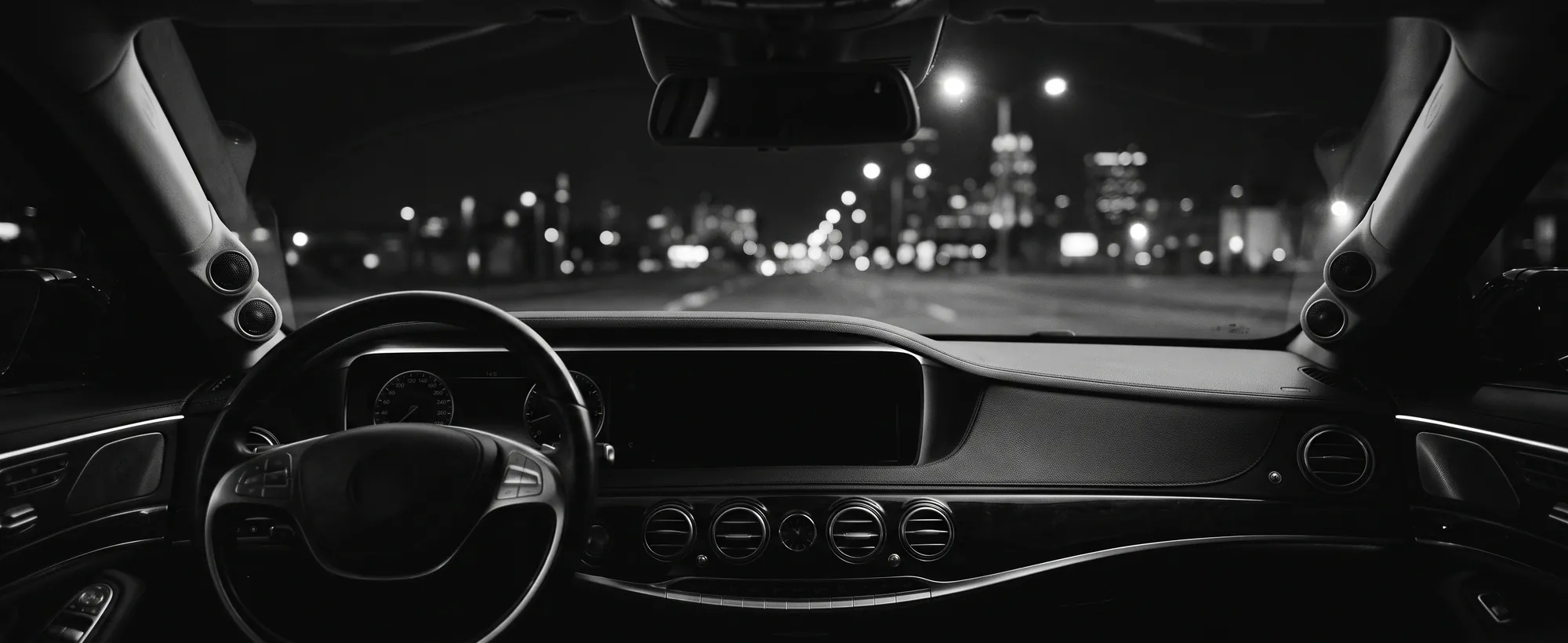
In a well set up car, a vocalist sits centred on the windscreen, roughly at the height of the rear-view mirror, and the instruments spread evenly across the dashboard. In most cars straight from the factory, the singer sits somewhere near your left knee. The speakers did not fail. The geometry did.
Nothing about a car is kind to stereo imaging. The two front speakers are at different distances from your head, they fire across your legs instead of at your ears, and the cabin is small enough that the first reflection arrives almost on top of the direct sound. A DSP is what compensates for all of it.
Why the stage collapses toward the near door
Sit in the driver's seat and measure it. The left door speaker might be 60 cm from your ear; the right one is closer to 110 cm. Sound covers that extra 50 cm in about 1.5 milliseconds, and it arrives quieter, because level falls with distance.
Your ear resolves that as direction. This is the precedence effect: when the same sound reaches both ears with a small delay, you localise it toward whichever side arrived first. A millisecond and a half is more than enough to drag the entire stage into the near door. It is why a passenger and a driver in the same car hear two different systems.
What time alignment actually does
A DSP delays the near speaker so both arrive together. In the example above, the left channel is held back by about 1.5 ms — a number derived from the measured distance, not chosen by ear. Once both channels arrive at the listening position simultaneously, the phantom centre snaps back to the middle of the windscreen.
This is the single change that surprises people most. No new hardware, no more power, and the stage moves a metre forward and lifts to eye level. It also costs nothing in the parts budget, which is why we tune before recommending an upgrade.
Level, crossovers and the rest of the tune
Channel levels. Once timing is right, left and right are matched at the listening position so the centre stays centred at every volume.
Crossover points and slopes. Door mids are told where to stop and tweeters where to start, so the handover is seamless and neither driver is asked to work outside its comfortable range. Getting this wrong is the usual cause of a stage that splits in two — voices at the dash, sibilance at the A-pillar.
Phase alignment through the crossover region. Two drivers overlapping out of phase cancel each other exactly where the vocal lives.
Equalisation last, and sparingly. EQ corrects the response curve; it cannot fix a timing or phase problem, and using it to try is how systems end up thin and fatiguing.
Why it has to be measured
Every one of those settings depends on distances and a response curve specific to your car, your seat position and your speakers. A tune copied from another vehicle is a guess. We measure with REW and a calibrated microphone at the actual listening position, set delays from the measured arrival times, and verify the result rather than assuming it.
The tune also travels: standalone DSP calibration is one of the few things we do outside Coimbatore, because it needs the car and a measurement rig, not a workshop.
What to expect
A properly aligned system sounds wider than the car is, centred on the windscreen, and stable — the stage stays put as you change volume. Detail that was masked by smeared timing becomes audible. Most people describe it as the system sounding louder at the same volume, which is really just clarity being mistaken for level.
Speaker choice affects the stage too — component speakers vs coaxial speakers explains why a separated tweeter gives a DSP more to work with. If you are weighing the whole job, is DSP tuning really necessary covers where it sits in the budget.