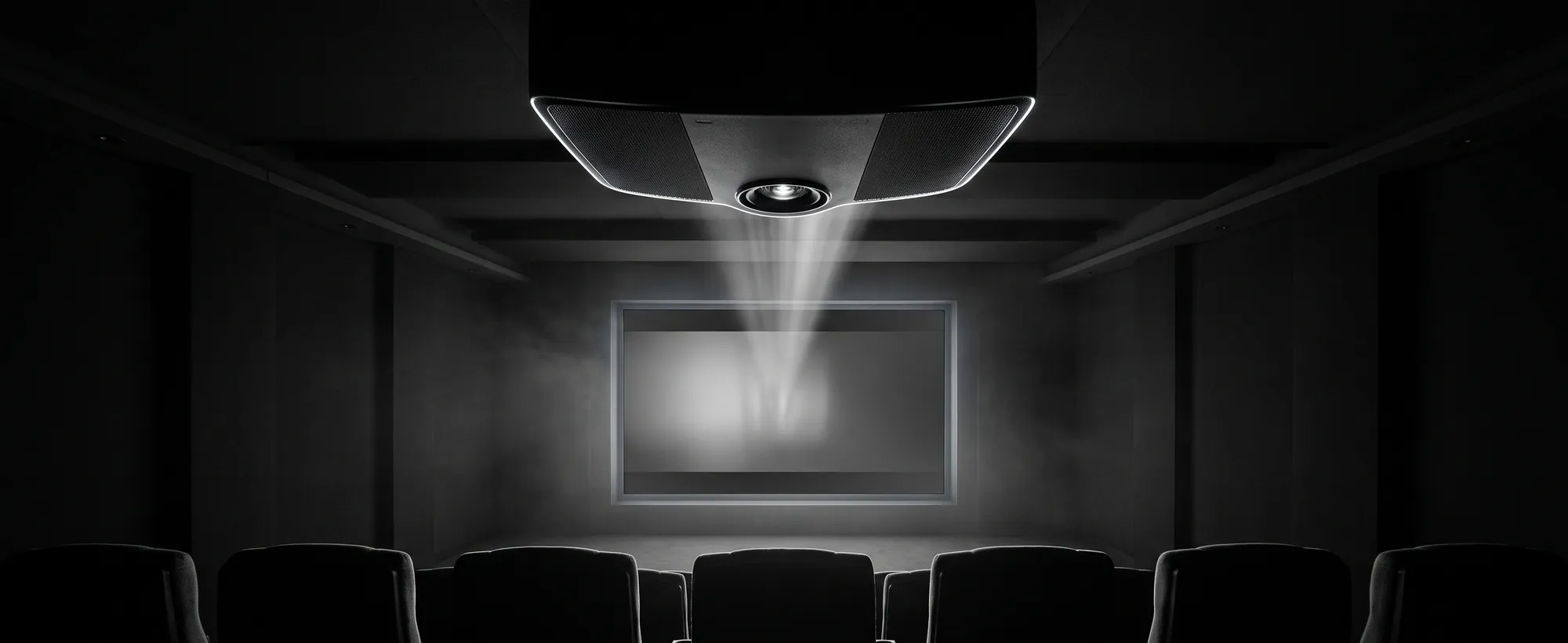
A 135-inch screen is not a bigger television. At normal seating distance it fills enough of your field of view that you stop looking at a rectangle and start looking into a space. That transition happens at a measurable point, and it is the whole argument for a projector.
It is also not the right answer for every room. Here is where each one wins.
The number that matters is viewing angle, not inches
SMPTE recommends the screen span at least 30 degrees of your horizontal field of view for cinema content; THX pushes toward 40. From a sofa 4 metres back, hitting 36 degrees takes roughly a 130-inch diagonal. The largest consumer televisions top out around 98 inches, which from that same seat gives you about 26 degrees.
That gap is why people describe a projector room as immersive and a large television as merely big. You cannot close it by buying a slightly larger TV; the sizes do not exist.
Where a television genuinely wins
Ambient light. A modern OLED or mini-LED is watchable in a bright living room. A projector is not, at any price, without controlling the light.
Absolute contrast and peak brightness for HDR highlights. A good television still beats a good projector here.
Casual use. Nobody wants a 10-second warm-up to check a cricket score.
This is why we often specify both: a television for daily viewing, a projector in a room built for films.
What actually makes a projector room work
The projector is maybe a third of the result. The rest is the room, and this is where most installations go wrong.
Light control. A projector produces a fixed number of lumens; every reflective surface in the room subtracts from the contrast it can deliver. Dark walls and ceiling, blackout curtains and no gloss finishes matter more than the next model up. A mid-range projector in a properly dark room outperforms a flagship in a white one.
Screen gain matched to the room and throw distance. A high-gain screen narrows the viewing cone; get it wrong and the seats at either end see a dimmer picture than the middle.
Throw distance and lens shift, calculated before anything is mounted. Keystone correction is a last resort — it discards real pixels to square the image.
Acoustic treatment. The screen makes the room feel like a cinema; the reverberation time is what makes it sound like one. How room acoustics affect home theatre sound covers what treatment fixes and what it does not.
Seating distance and rake, set from the screen size rather than the shape of the room.
Laser versus lamp
Laser light sources have effectively ended the lamp-replacement argument: 20,000 hours of rated life against 2,000–4,000, no consumable to source, and stable colour over that life rather than a slow drift toward yellow. At Indian electricity and lamp prices the higher purchase cost is usually recovered inside the ownership period.
How we approach it
We start from the room and the seating, not the product list. Measured throw distance, measured ambient light, measured reverberation time; the projector, screen size and gain follow from those. A specification that ignores the room produces an expensive picture in a space that cannot show it.
We design and install home cinema rooms across Coimbatore, Bangalore, Chennai, Kochi and Hyderabad. If you are choosing a layout first, 5.1 vs 7.1 is the place to start.